Borders as a Guarantee of Security?
Jussi P. Laine
Festive address at the annual celebration of the Finnish Cultural Foundation’s North Karelia Regional Fund on 23 May 2026.
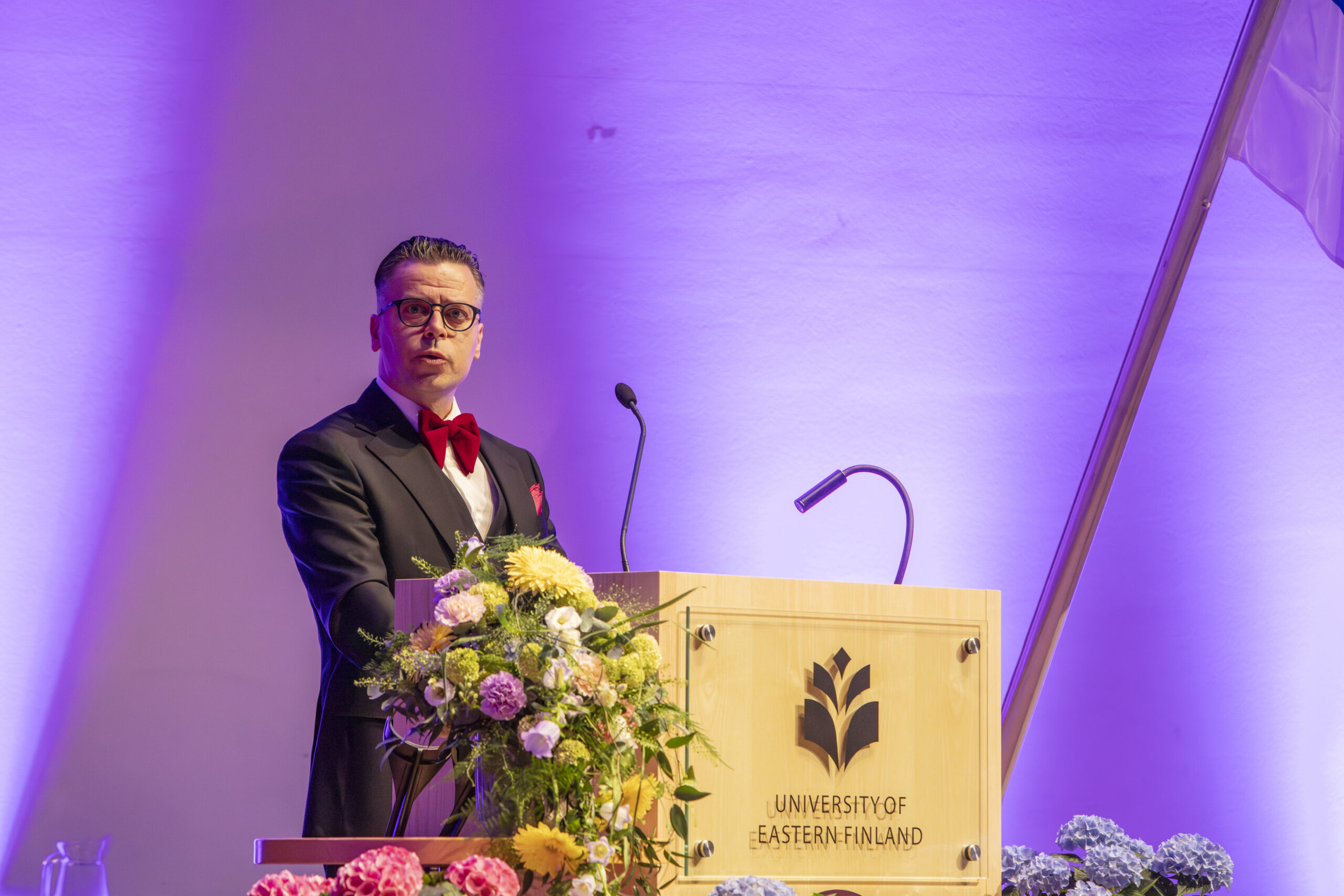
Esteemed representatives of the Finnish Cultural Foundation’s North Karelia Fund, dear grant recipients, honored guests, dear friends of culture,
I wish to extend my warm gratitude for the invitation to participate in this celebration and to speak at this distinguished occasion.
The work of the Finnish Cultural Foundation in support of Finnish science, art, and culture has been exceptionally meaningful – not only as a patron of cultural life, but also as a builder of social trust, civic education, and faith in the future.
Here in North Karelia in particular, this work carries its own special weight.
In border regions, people perhaps understand more concretely than most how vital culture is to the continuity, identity, and sense of belonging of communities.
Culture here has never been merely a question of leisure – it is part of how people survive, remember, meet change, and build the future.
It is a great joy and honor to speak here in Joensuu, North Karelia – a region where borders have never been merely lines on a map. Here, borders have been part of everyday life, memory, identity, movement, longing, encounter – and sometimes also fear.
I also wish to offer my warmest congratulations to today’s grant recipients. Every grant awarded is far more than financial support. It is an expression of trust – a message that research, art, cultural work, and new ideas matter to our society.
Ladies and gentlemen, the title of my speech is: “Borders as a Guarantee of Security?”
The question mark in the title is important. It is not decorative. It is the very heart of this address.
When Asko Saarelainen and Jopi Nyman were thinking about what theme they would like me to speak on, they suggested “Borders and their security.”
I was happy to take up the suggestion – but only on the condition that the title itself may also be challenged. For without a critical gaze, the security of borders easily becomes a self-evident assumption that is never truly examined.
And that is precisely what the question mark points to.
What does border security actually guarantee? For whom does it guarantee anything? And above all: what happens if strengthening borders does not in fact lead to broader security for society and its people?
If border security does not serve the security of people, its value is inevitably limited – perhaps even a mere symbol that promises more than it can deliver.
That is why I want to examine border security not only as an institutional goal, but also as a political instrument that can either build or narrow the experience of security.
Right now, in Europe and across the world, borders have returned to the center of politics, security, and public debate in ways we perhaps could not fully have imagined even ten years ago.
Russia’s war of aggression against Ukraine, geopolitical confrontation, hybrid influence, disinformation, migration, economic uncertainty, and the internal polarization of societies have made security the defining question of our era.
At the same time, borders have changed.
They no longer exist only at the edges of states. Borders are increasingly everywhere – and yet, at the same time, nowhere.
Our bounded world has become ever more constrained.
They appear in language, media, algorithms, identities, urban spaces, culture, human interaction, and in the way we conceive of “us” and “them.”
And perhaps that is precisely why we need culture today more than ever in order to understand security.
Security is still most often understood primarily in physical terms: border control, military defense, the capacity to counter threats.
But in the present state of the world, it becomes ever harder to think about security solely through the lens of national sovereignty or traditional security policy.
Security is no longer only a question of who may enter and who is kept out. Security is also an experience. Without a sense of wellbeing, inclusion, and meaning, security cannot be sustainable.
Security without wellbeing is an illusion.
Security without trust is fragile.
Sustainable security requires that society be capable of responding to both external threats and internal challenges by strengthening the structures that make the future shared and life worth living.
This is precisely where the significance of culture becomes central.
The cultural policy report recently published by the Ministry of Education and Culture emphasized that culture is not a marginal phenomenon or a mere supplement to wellbeing. Culture builds inclusion, trust, and a sense of belonging – the very same factors from which societal resilience is ultimately built.
A strong shared message emerged: culture is not just an optional ornament in good times. Culture is part of society’s comprehensive security.
Minister of Science and Culture Mari-Leena Talvitie captured this aptly when she noted that culture builds inclusion, trust, and a sense of belonging – precisely those things whose significance is heightened in times of crisis.
And perhaps this is the core question of security’s future.
What holds society together when uncertainty grows? What is that invisible social glue – absent from statistics and budget lines – upon which everything else ultimately rests?
Not infrastructure alone. Not defense systems alone. Not institutions alone. And not borders alone – though they are often placed at the center of discussion.
For borders can certainly protect, but they cannot carry a society by themselves.
What truly holds us together is trust between people: the capacity to trust that another will act rightly even when systems are under strain and the future grows dark.
It is reciprocity – the sense that we are more to one another than passing strangers.
It is justice – the experience that treatment is fair even when times are hard.
It is the feeling of belonging – a quiet certainty that we are part of something greater than any single crisis.
It is hope – the ability to see the horizon even when visibility is poor.
Woven through all of this is also culture – not merely as art or tradition, but as a shared language through which we understand one another even when words run out.
Culture is the silent compact that tells us how we treat the stranger, how we help the vulnerable, how we build a common future.
It is our shared memory and our imagined future simultaneously.
Culture is what teaches us to recognize one another’s humanity before we recognize one another’s opinions.
It is the invisible rhythm that keeps society moving in the same direction even when the road is rocky.
It is the web of meaning that holds us together when nothing else feels certain.
All of this forms the invisible fabric that does not shine in headlines but that carries society when nothing else can.
These are like quiet promises that people make to one another: that we will not abandon, that we will not close ourselves off, that we will not cease to see the humanity in each other.
That is why, in the midst of crises, the most important question is not only how we protect borders – but how we protect the cultural space in which trust, reciprocity, and hope can come into being at all.
Dear friends,
resilience – the capacity to withstand crisis – has emerged in recent years in almost every sphere: politics, research, media, and security strategies. Sometimes so much so that the concept itself risks becoming an empty buzzword.
But at its best, resilience means something deeply essential. Not merely the ability to recover from a crisis and return to what was before. But the ability to transform, to learn, and to renew.
The ability to face uncertainty without society losing its capacity to function – or its humanity.
Resilience is therefore not invulnerability.
It does not mean building fences or walls against everything unexpected. It is rather the capacity to live in a world where not everything can be controlled.
This matters for security policy as well. For many of the greatest security challenges of our time cannot be clearly bounded.
Hybrid influence does not stop at a border crossing.
Disinformation requires no passport.
Distrust spreads faster than any army moves.
And viruses cross borders even more effortlessly – often before we have even noticed they have set off.
And it is precisely the “soft” dimension of security – people’s experiences, fears, perceptions, and identities – that is most vulnerable to manipulation.
When societies begin to tear from within, this is not only a social problem. It is also a security issue.
In this situation, borders readily acquire symbolic significance. They are offered as a remedy for chaos.
Borders present themselves as a promise of clarity in a world that feels complex and uncontrollable.
But at the same time, the politicization of borders can also simplify problems in dangerous ways. When complex social crises are reduced to a question of “us” versus “them,” attention is diverted from the actual causes of those problems.
Borders then no longer only protect. They begin also to generate confrontation.
And it is precisely here that the role of culture becomes decisive.
Esteemed audience,
border security is often also symbolic politics.
It is visible, easily communicated, and politically effective at a time when many of the phenomena that undermine security are slow-moving, global, and difficult to grasp.
Border measures provide a concrete stage on which political agency can be made visible – a way of signaling that the state is capable of protecting, managing, and restoring order.
In modern politics, it sometimes appears that the visible performance of sovereignty has become almost as important as its actual exercise.
Border fences are a good example of this. They are visible, concrete, and easily communicated symbols: tall, technological, expensive, and above all photogenic structures.
They can be staged as media events.
They demonstrate that someone is “doing something.” And that is precisely why they are politically effective.
A border fence offers a simple and easily understood answer to a complex problem.
The political message is clear: “We are taking care of you.”
At the same time, the security problem is located beyond the border – somewhere “over there.”
The solution offered is a concrete measure: a barrier, surveillance, control. And at the same time, agency is demonstrated: decisiveness, strength, and a protective posture.
In such a framing, alternative approaches can easily be presented as naive, weak, or even dangerous. As simply wrong.
In this sense, border security is not merely a technical or legal question. It is also an affective and symbolic process.
Borders produce a feeling of security at a time when uncertainty feels structural and permanent.
In an unstable world, borders can function as psychological anchors – signs that something remains fixed, distinguishable, and governable.
They reassure us that “we” and “this place” are still separable and protectable.
But it is equally important to remember that reinforcing borders does not necessarily remove the underlying causes of insecurity.
Physical barriers alone do not resolve distrust, social inequality, polarization, or the experience of exclusion.
And that is precisely why security cannot be built through borders alone.
We also need those social structures that strengthen trust, inclusion, and shared faith in the future. And this is precisely where the significance of culture becomes central.
Culture has always been closely bound up with borders.
On one hand, culture constantly crosses them. Music, literature, language, memories, ideas, and art move across state borders almost unnoticed.
But culture is also used in the construction of borders.
The idea of “our culture” can, at its best, create community and continuity.
But at its worst, culture becomes an instrument for excluding others.
The economist and philosopher Amartya Sen has reminded us that identity becomes dangerous when a person is forced into a single, fixed definition.
When people are seen only through the lens of nationality, religion, ethnicity, or culture, the world begins to simplify in ways that feed conflict. Culture can then become an instrument of fear, suspicion, and the exercise of power.
But culture can also act in the opposite direction.
It can open space for diversity. For plurality of voices. For empathy. It can help us see that identities are not fixed and immutable.
In border regions especially, this is often understood in very concrete terms.
North Karelia is, in this sense, a distinctive place.
The border here is not an abstract concept.
People here know that borders can simultaneously divide and unite.
Border regions are living laboratories in which national narratives are in constant dialogue with the realities of everyday life.
Here, people know that the world never divides quite so neatly into inside and outside.
In border regions, people often inhabit several realities at once.
That is precisely why border regions can teach us something essential about the future of security.
Security does not arise only from closing borders. Security also arises from the capacity to live alongside different people, experiences, and perspectives.
In border studies, a profound shift has taken place in recent years.
Formerly, borders were understood primarily as geopolitical and administrative structures.
Now we understand ever more clearly that borders are also cultural and psychological phenomena.
Borders do not only exist on maps.
They exist in people’s minds, in narratives, and in everyday practices.
That is why art and culture are not peripheral to the study of borders.
They are central.
Artistic and cultural practices show us how communities imagine themselves. How they construct understandings of belonging, identity, and security.
And that is precisely why culture is an indispensable part of social change as well.
Russia’s war of aggression against Ukraine illustrates this with particular clarity.
The war is not only about territorial integrity or military conflict.
At its core lie also history, language, memory, identity, and culture.
The question of who gets to tell history.
Who belongs to the people.
Whose language and culture is recognized.
That is why the post-war peace will be more than the silencing of weapons.
It will also be a cultural process.
Esteemed audience,
at the closing event of the Cultural Tour held last month at the House of the Estates in Helsinki, a theme that emerged with particular prominence was young people’s faith in the future.
The CEO of the Finnish Cultural Foundation, Susanna Pettersson, drew special attention to the weakening of young people’s belief in the future and to culture’s role in rebuilding it.
The erosion of young people’s faith in the future is a question for society as a whole, and art and culture have a decisive role in strengthening the sense of inclusion and belonging.
This is perhaps the single most important long-term security question.
If young people lose their faith in the future, society’s resilience begins to erode from within.
Culture gives people the possibility of seeing themselves as part of something larger.
The possibility of imagining futures. The possibility of being seen and heard.
That is why culture is not an expenditure – it is an investment in the durability of society.
And that is precisely why the accessibility of culture matters so deeply.
The opportunity to engage with art and culture must not depend on postal code, wealth, or ability.
Culture belongs to everyone.
Not only to large centers.
Not only to those who already have a voice.
In the age of digitalization, this takes on a new dimension as well.
In the discussion I mentioned earlier, arts student Björn Teir observed astutely that what is not digitized will not be transmitted to future generations – nor will it enter the worldview being shaped by artificial intelligence.
This is an enormously important insight.
Cultural heritage is not only the past.
It is also the intellectual capital of the future.
If we do not tend to languages, memory, and cultural narratives, others will begin to define them on our behalf.
That is precisely why cultural resilience is also a defense of democracy.
Dear friends,
perhaps the future of security will ultimately be decided not only by how strong the borders we build are – but by what kind of societies we build within those borders.
Do we build societies in which people feel they belong together?
Societies in which difference does not automatically appear as a threat, but as an opportunity to understand the world more fully?
Societies in which culture is seen as an investment in a shared future – not an expenditure to be cut in hard times?
A resilient society is not a closed society.
It is a society capable of changing without losing its ability to trust, to listen, and to imagine a shared tomorrow.
And it is here that the significance of culture is irreplaceable.
Culture sustains memory when the world changes rapidly. It builds connection when society threatens to fragment. It creates meaning in an era marked by uncertainty, accelerating polarization, and restlessness.
Perhaps that is why culture is not the opposite of security.
Culture is one of security’s deepest foundations.
And perhaps, in the end, a society’s strongest borders are not the ones that separate us from one another – but those shared values, civic culture, trust, and humanity that hold us together even in uncertain times.
On those foundations, faith in the future is also built.
And without faith in the future, there is no sustainable security.
Thank you.